
From work items
To relationships and intent
Make dependencies and planning intent visible alongside the work your team already tracks.
Purpose-built planning software
Smaller Chunks creates focused tools for teams that need to estimate with confidence, plan with clarity, and keep delivery visible.
Azure DevOps ready Tools that seamlessly and simply integrate into your existing DevOps project—no matter how it is structured.


Why Smaller Chunks?
Keep your projects, processes, and backlogs. Add focused views that help your team decide what to do next.
From work items
Make dependencies and planning intent visible alongside the work your team already tracks.
From delivery data
Turn Azure Boards data into focused views of progress, risk, and the conditions that need attention.
From execution
Connect planning, delivery, and release communication so everyone can see how the work serves the outcome.
Our products
Explore working demos of six focused products, each built for a moment where delivery teams need more clarity, shared context, and momentum. Marketplace release is coming soon.
The Smaller Chunks product suite
Adopt one product where clarity is needed most, or connect all six as an Azure DevOps extension spanning planning, estimation, mapping, delivery intelligence, collaboration, and release communication.
Request early access Tools
Define value and shape the delivery plan.

Estimate effort and expose uncertainty.

See the story and what affects it.

Monitor the process and make conditions decision-ready.

Close delivery gaps in one shared view.

Turn completed work into release notes.


App 01
Break complex initiatives into a visible hierarchy of milestones, sequence dependencies, and keep the path to delivery clear.
Plan value independently and ahead of delivery, then couple every chunk to its implementation work—regardless of project, team, process, or backlog structure.


App 02
Run real-time estimation sessions with configurable scales, clear participant roles, timed discussion, objections, and consensus.
Estimate required effort early so management can align capacity, skills, and people to the right teams before a gap threatens delivery.


App 03
See Azure Boards work-item relationships as an interactive card map with clear link direction and relationship labels.
Map planning intent to existing Azure DevOps work items without forcing a new project, process, hierarchy, or backlog structure.


App 04
Turn live Azure Boards work into live, decision-ready dashboards without moving delivery data into another reporting system.
Choose the work that matters, shape the signal for each audience, and keep changing conditions visible in Azure DevOps or on a rotating kiosk display.


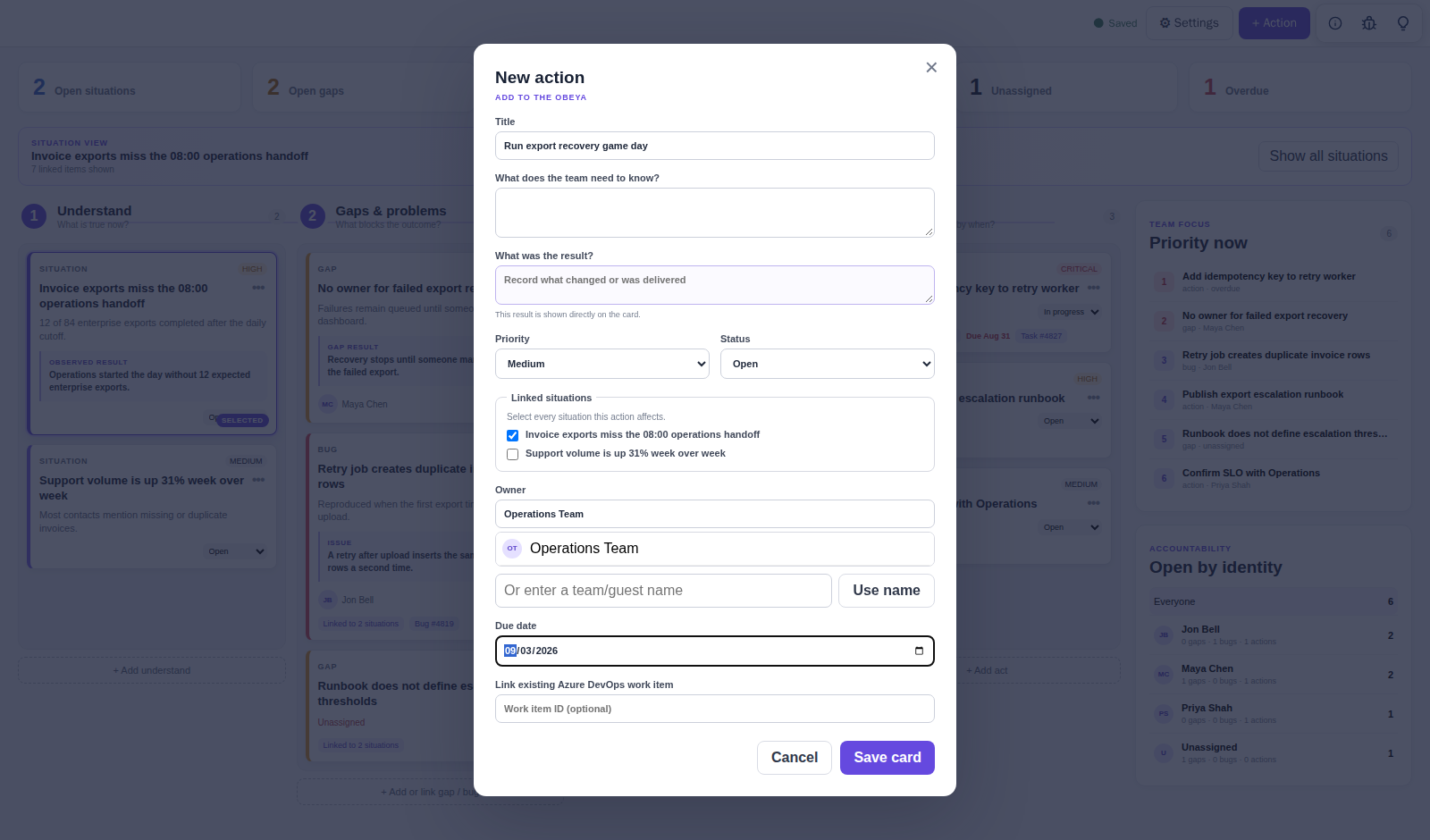


App 05
Move together from understanding the current situation to exposing gaps, recording decisions, and following through on owned actions.
Make bugs, gaps, decisions, owners, priorities, and due dates visible without forcing the team into a new Azure DevOps hierarchy.


App 06
Use Azure Boards parent-child relationships and completed work to assemble clear release notes without maintaining a separate reporting backlog.
Keep release communication connected to the work itself. Generate, review, and publish notes as one small final chunk—not someone’s full-time reporting job.
Supporting tools for Azure DevOps
Our original six products connect the end-to-end process, from planning and estimation to delivery and release communication. These tools support everyday work alongside that process.

Make work-item descriptions easier to write and read. Use rich HTML formatting, colors, highlights, and table controls, or switch to standard Markdown with a matching toolbar.
Supports clear descriptions, acceptance criteria, and other rich-text fields.
Explore Better Editor
Bring WIQL-driven work item charts and pipeline health onto your Azure DevOps dashboards. Configure one chart per card with filters, grouping and daily trends.
Use Monitor-style query settings in a focused dashboard frame.
Explore Dashboards
Build work-item filters with familiar fields and operators, preview matching results, and copy or save the WIQL Azure DevOps will run—without drafting query syntax from scratch.
Supports shared queries and backlog triage on Azure DevOps Boards.
Explore Filter
Download the complete Smaller Chunks wallpaper collection for desktop monitors and phones, including product editions and professional corporate designs.
Available in multiple landscape and portrait resolutions.
Explore WallpapersHow we think
We build around the way teams actually work: shared context, visible tradeoffs, and less time spent managing the tool itself.
Important information stays visible, understandable, and close to the decision it supports.
Tools belong inside the systems teams already use—not in another disconnected destination.
Interactions stay purposeful so teams can spend their energy on planning and delivery.
Built with intent